

Handmade vs Machine-Made Bags: Which Gives Better Value?
Hamna Fatima6 min read
A fair comparison of handmade and factory-made bags so you can decide where craftsmanship is worth the extra cost.
Handmade vs Machine-Made Bags: Which Gives Better Value?
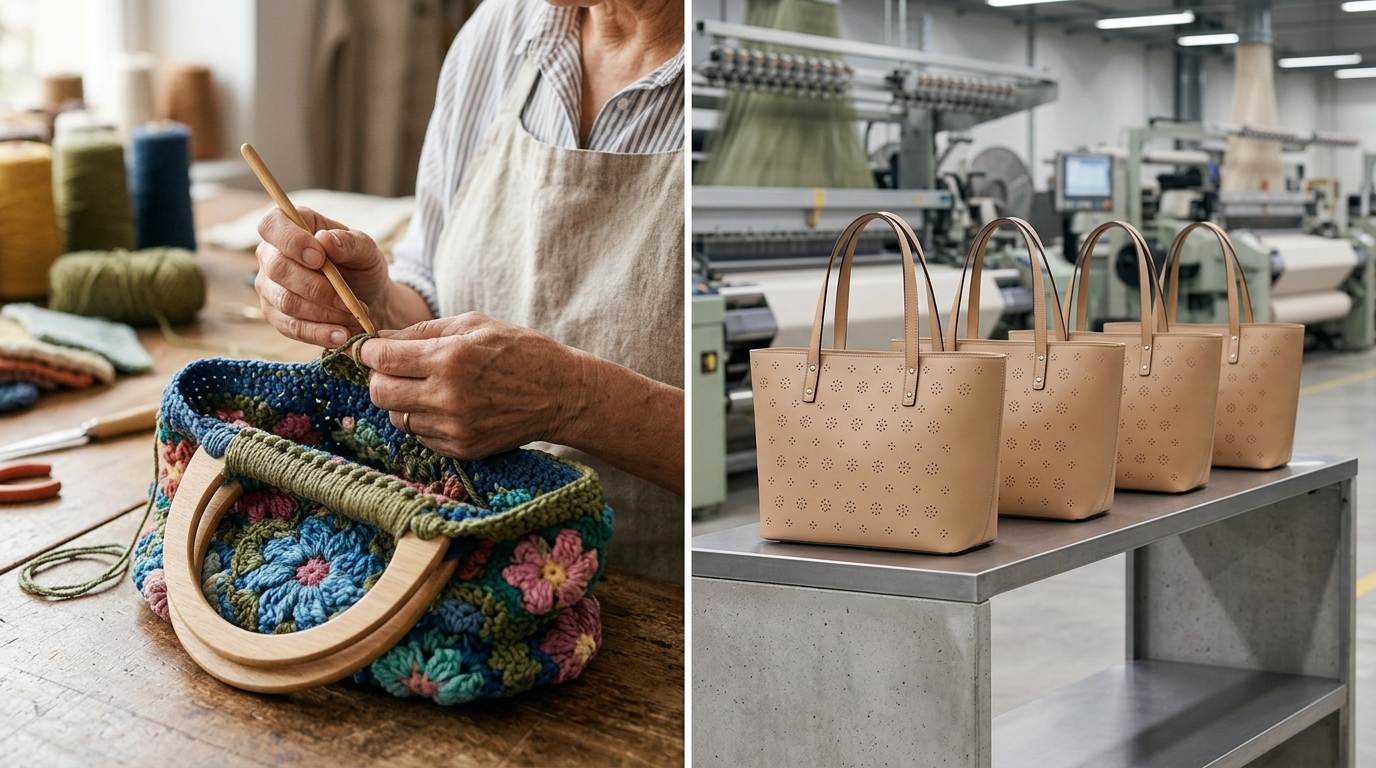
When comparing handmade bags in Pakistan with factory-made options, the lowest price isn't always the best value. A machine-made bag can be practical, consistent, and easy to replace, while a handmade bag may offer better craftsmanship, reparability, individuality, and a longer relationship with the product. The right choice depends on how you use a bag, what you expect from it, and how much you are comfortable investing. This guide offers a fair, buyer-focused comparison of handmade and machine-made bags, with Pakistan-specific considerations such as PKR pricing, delivery, access to repairs, weather, and everyday use. The goal is not to say that one option always wins, but to help you spend your money wisely.
How Each Is Made
Machine-made bags are generally produced through repeatable factory processes. Cutting, stitching, assembly, and finishing can be standardised across hundreds or thousands of pieces. That consistency is a genuine advantage when you want the same shape, colour, and specifications every time. Handmade bags follow a slower, more hands-on process. An artisan may select materials, prepare individual components, crochet or stitch sections, join them, add lining and hardware, and inspect the final piece personally. For buyers comparing handmade vs machine made bags, the key difference is not simply 'hand versus machine'. It is the amount of human attention involved at each stage and how that affects the final product.
Finish & Quality
Factory production can deliver very clean, uniform finishes, particularly when a brand has strong quality-control systems. Seams, dimensions, and hardware placement are usually designed to be consistent. Handmade pieces can have small variations because they are made by people rather than a single automated process. Those variations are not automatically defects. In a well-made artisan bag, the important signs are secure joins, even tension, strong handles, neat lining, and properly attached hardware. When shopping for handmade bags in Pakistan, inspect the areas that carry the most stress: handle attachment, base construction, closures, and inner seams. A beautiful exterior matters, but practical construction matters more.
Uniqueness & Personalisation
This is where handmade bags often have a clear advantage. An artisan can work with distinctive colour combinations, textures, shapes, and details that are difficult to reproduce exactly at mass-market scale. Some Pakistani makers also offer limited batches or small custom changes, such as colour choices or strap details. That can make a bag feel more connected to your wardrobe rather than like an item everyone already owns. Machine-made bags are better if you want predictable consistency. If you need ten identical bags for an organisation, event, or uniform look, factory production is usually the sensible choice.
Durability & Longevity
Durability depends more on materials and construction than on whether a bag was made by hand or machine. A poorly constructed handmade bag can wear out quickly, while a well-engineered factory bag can last for years. For everyday use in Karachi, Lahore, or Islamabad, consider heat, dust, humidity, commuting, and how much weight you normally carry. Look for reinforced handles, a stable base, quality lining, and hardware that does not feel flimsy. A useful value test is cost per year. A PKR 3,000 bag that lasts one year costs roughly PKR 3,000 per year. A PKR 7,000 bag that remains useful for three years costs about PKR 2,333 per year. The higher upfront price may therefore make sense when the construction genuinely supports a longer life. Repairability & Maintenance Repairability is one of the quieter benefits of buying from an artisan or small local maker. If a handle loosens, a seam opens, or a closure needs attention, you may be able to contact the maker directly rather than replacing the whole bag. That does not mean every handmade bag is repairable, and repair policies vary. Before buying, ask whether small repairs are supported, whether spare hardware is available, and who handles post-purchase issues. Machine-made bags can also be repaired, especially when replacement parts are standard. However, inexpensive, fast-production bags are sometimes less economical to repair than to replace. Price: What You're Actually Paying For Price is often the biggest hesitation for buyers. In Pakistan, you may find simple factory-made bags around PKR 1,500–4,000, while better-quality branded or structured bags can cost considerably more. Handmade crochet and artisan bags commonly sit around PKR 3,500–10,000 or higher, depending on materials, size, detail, and labour. These are broad market examples rather than fixed price rules. A handmade price includes the maker's time, material waste, skill, finishing, small-batch production, and often packaging and direct customer service. With a machine-made bag, the cost structure benefits from scale. If your priority is simply the lowest possible upfront cost, machine-made is likely to win. If you value craftsmanship, uniqueness, local production, and a product you intend to keep, handmade may offer stronger overall value.
Sustainability & Environmental Impact
Handmade production can support a lower-waste model because artisans often make smaller quantities and can work closer to actual demand. Buying locally can also reduce some of the distance associated with imported products. Still, handmade does not automatically mean environmentally perfect. Materials have environmental costs, delivery creates emissions, and producing a durable item still requires resources. Likewise, a machine-made bag is not automatically wasteful if it is well designed and used for many years. The most useful question is: Will you use the bag for a long time? The strongest case for slow fashion bags is not simply how they are made, but whether they help you buy fewer, better-used products.
Who Should Choose Handmade (and Who Shouldn't)
Choose handmade if you care about distinctive design, visible craftsmanship, small-batch production, custom details, local maker support, and the possibility of repair. For shoppers researching artisan bags Pakistan has to offer, these qualities can make the extra investment worthwhile. Choose machine-made if your priority is a lower upfront price, immediate availability, identical replacement options, or a highly standardised design. There is nothing wrong with choosing the practical option when it fits your budget and routine better. For many buyers, the best decision is not handmade versus machine-made in absolute terms. It is choosing the bag that matches your actual priorities. A carefully made artisan piece can justify a higher price when you will use it often, while a lower-cost factory bag can be the smarter purchase when budget and convenience come first.
Explore Our Handmade Crochet Bags
Ready to compare styles for yourself? Explore our handmade crochet bags:Crochet Bags Check the construction, dimensions, materials, and price of each piece, then choose the one that fits your wardrobe and everyday routine.
FAQs
Are handmade bags in Pakistan worth the higher price?
They can be, especially when the bag uses quality materials, strong construction, and distinctive craftsmanship. The value is strongest when you plan to use and keep the bag for a long time.
What is the main difference between handmade and machine-made bags?
The main difference is production method and scale. Handmade bags receive more direct artisan attention and may vary slightly, while machine-made bags are designed for repeatability and consistency.
Where can I find artisan bags in Pakistan? Can shoppers buy locally?
Look for established local makers and small artisan brands, and check their material details, construction, customer reviews, delivery terms, and repair policy before ordering.
Are slow fashion bags always more sustainable?
Not automatically. Sustainability depends on materials, production, shipping, and how long the bag is used. A durable bag that replaces several short-lived purchases can offer a stronger environmental benefit.
What should I check before buying a handmade bag?
Check the handle attachment, base, lining, closures, material quality, dimensions, weight capacity, delivery terms, and whether the maker offers repairs or after-sales support.
Ready to find yours?
Free delivery over Rs 5,000, cash on delivery, and Rs 200 off when you pay online.
Shop the collection